
The tiny numbers that tell the truth
Pick up any gold bangle, ring, or chain and look inside the band or on the clasp. You will often find tiny stamped numbers or letters: 916, 750, 22K, 585. Most people never notice them. Those little marks are the most honest thing about the piece, because they declare the gold purity in a code the whole trade understands.
Learning to read them takes five minutes, and it changes how you shop. You stop taking a seller’s word for purity and start verifying it yourself.
Karat marks: the familiar ones
The marks you already know are the karat stamps: 24K, 22K, 21K, 18K, 14K. They state the karat directly. If you want the full story of what each karat means for wearing and value, our gold purity guide covers it in depth. The stamp is simply the maker’s declaration of which karat the piece was made in.
One common confusion: karat with a K is gold purity. Carat with a C is a diamond’s weight. They sound identical and mean completely different things. A “22K” stamp is about gold. A “1 carat” stone is about the diamond.
Fineness numbers: the code behind the karat
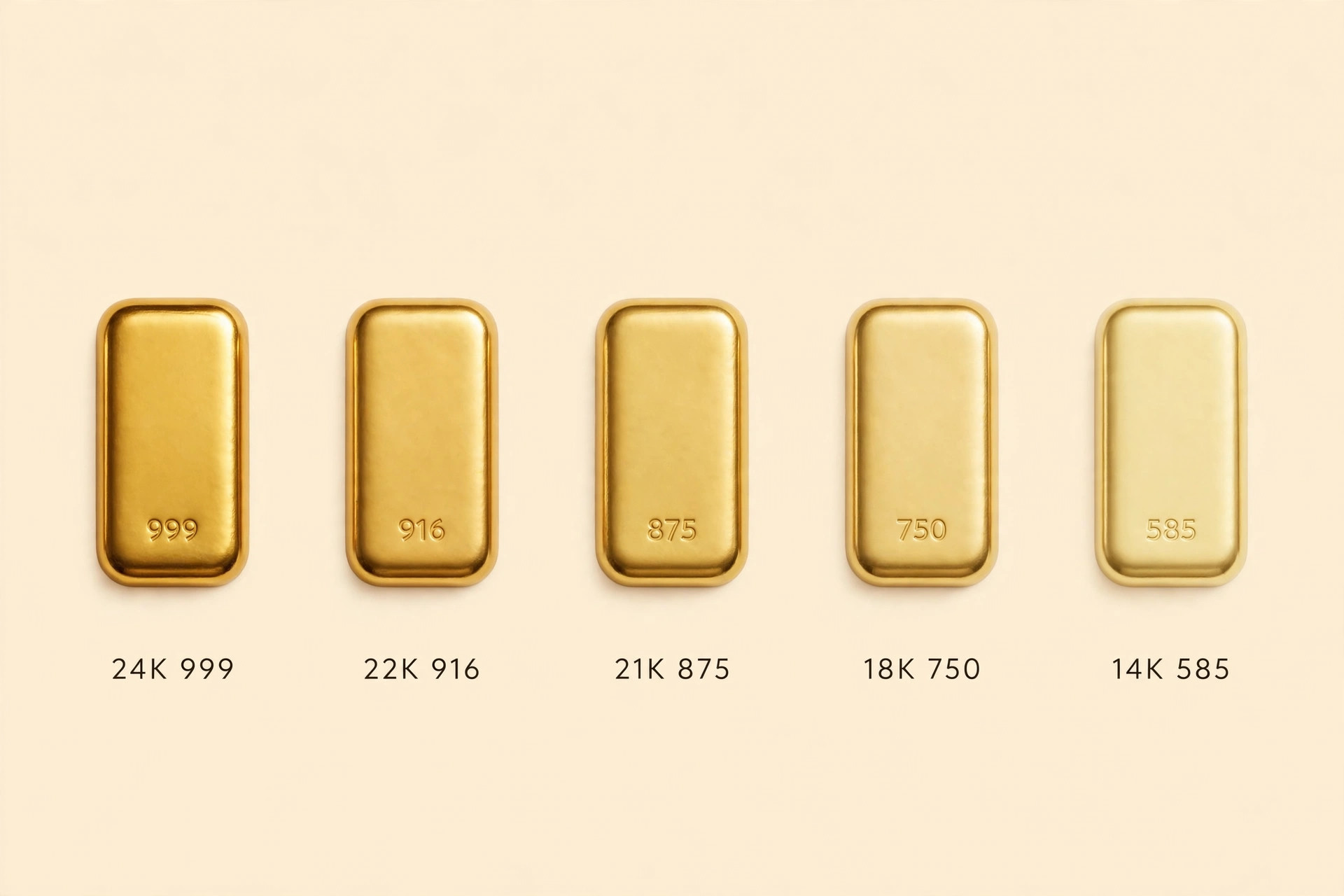
Alongside or instead of the karat, you will see three-digit numbers. These are fineness marks, parts of pure gold per thousand. They say the same thing as the karat, just more precisely:
| Stamp | Means | Karat |
|---|---|---|
| 999 | 99.9% pure gold | 24K |
| 916 | 91.6% pure gold | 22K |
| 875 | 87.5% pure gold | 21K |
| 750 | 75.0% pure gold | 18K |
| 585 | 58.5% pure gold | 14K |
| 417 | 41.7% pure gold | 10K |
| 375 | 37.5% pure gold | 9K |
So when your bangle is stamped 916, that is the trade’s way of saying 22K. A ring stamped 750 is 18K. The number is simply the karat divided by 24, multiplied by 1000. Once you know the table, you will read these stamps the way a jeweller does.
Where to find the stamp
On rings, the stamp sits inside the band. On bangles and karas, it is usually on the inner surface, sometimes near the joint. On chains and necklaces, check the clasp or the small tag attached to it. On earrings, look at the post or the back of the setting.
The stamp is small because it has to be. On fine jewellery there is not much flat surface to work with, so makers use tiny punches. A magnifying glass or your phone’s camera zoomed in will reveal what your eyes cannot.
What if there is no stamp?
An unstamped piece is not automatically fake, but it is unverified. Older handmade jewellery, especially pieces made decades ago by local karigars, often carries no mark at all. The gold can be perfectly genuine. But without a stamp, you are relying entirely on the seller’s word and your own testing.
For anything you buy new today, expect a stamp. A reputable jeweller stamps their work as a matter of pride. If a new piece has no purity mark and the seller brushes off the question, that is worth pausing over.
Hallmarking in Pakistan: the honest picture
Here is something worth knowing plainly. Pakistan does not have a single mandatory hallmarking authority for gold jewellery the way some countries do. There is no government office stamping every piece before sale. That means the system runs on the reputation of the jeweller and the detail on your bill.
This is why your purchase bill matters more than the stamp. A proper bill states the weight, the karat, the rate applied, and the making charges separately. The stamp tells you what the maker claims. The bill is the document that holds them to it. Always get both, and keep the bill somewhere safe. It is also what makes future resale and exchange straightforward.
A quick verification habit
Before you buy, do three things. First, find the stamp and read it using the table above. Second, ask the seller to confirm the karat verbally and watch that it matches the stamp. Third, check that the bill states the same karat and the exact weight. If all three agree, you are buying with your eyes open. That is all any buyer needs.