
Why Pakistan weighs gold differently
Walk into a jewellery shop in Lahore and the conversation happens in tolas and mashas, not grams. These traditional units have weighed gold in South Asia for centuries, long before the metric system arrived. They are still the language of the trade, the language of wedding shopping, and the language your grandmother used. Worth learning properly.
The system is beautifully logical. Each unit divides neatly into the next, so conversions are simple once you see the ladder.
The ladder: ratti to ser
| Unit | Equals | In grams (approx) |
|---|---|---|
| 1 ratti | the base unit | 0.1215 g |
| 1 masha | 8 ratti | 0.972 g |
| 1 tola | 12 masha (96 ratti) | 11.664 g |
| 1 chhatank | 5 tola | 58.32 g |
| 1 ser (sair) | 16 chhatank (80 tola) | 933.1 g |
Read it upward: 8 rattis make a masha, 12 mashas make a tola. That is the whole system. Everything else is built from those two facts.
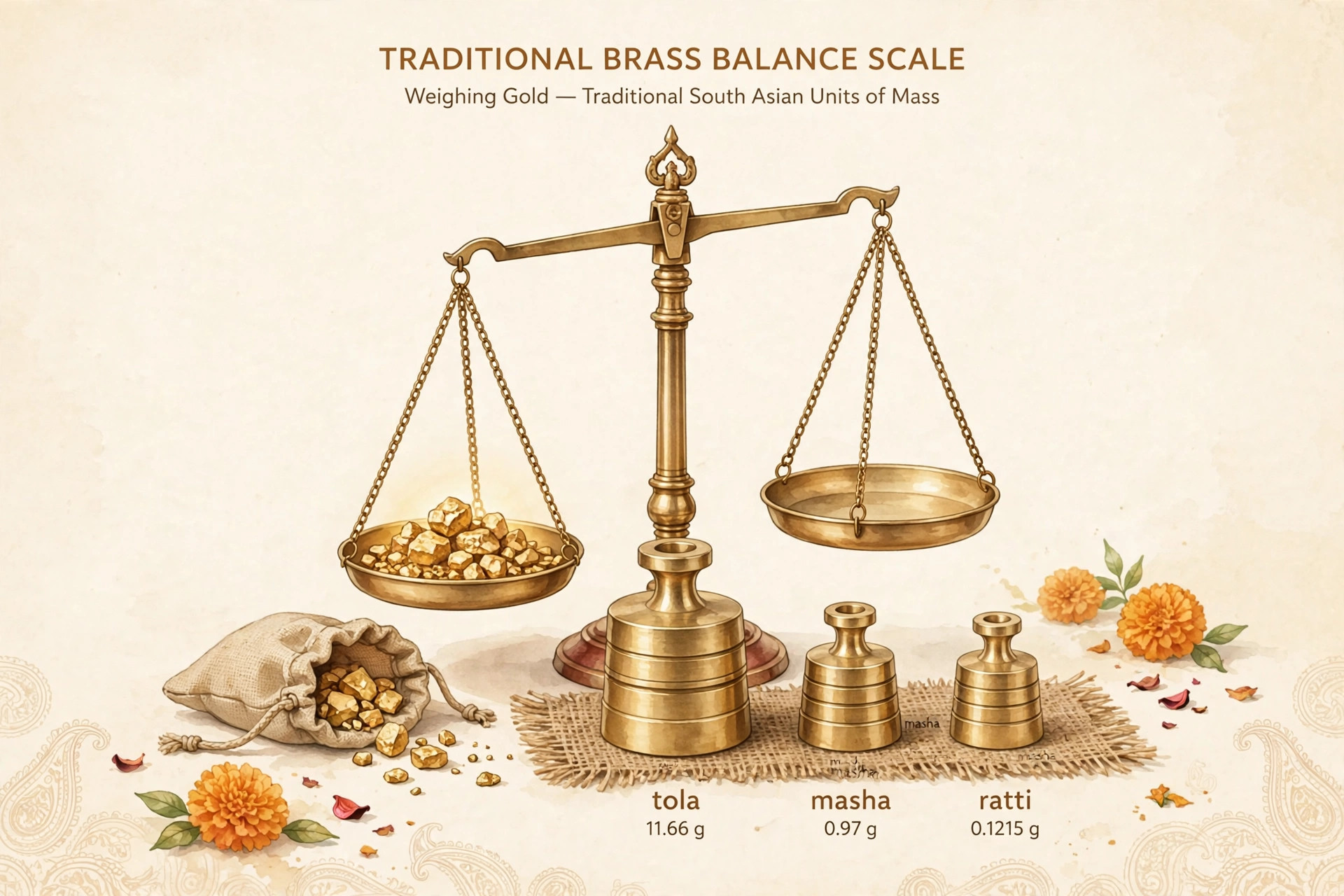
Tola: the king of units
The tola is the unit everything revolves around. Gold rates in Pakistan are quoted per tola. Wedding jewellery is discussed in tolas. “She got three tolas” is a complete sentence at a Pakistani wedding.
One standard tola equals 11.6638 grams, usually rounded to 11.66 g in shops. One thing to know: some bullion markets use a “market tola” (bazari tola) of 12.5 grams. When someone quotes you a weight, it is worth confirming which tola they mean, because the difference is about 7 percent. For jewellery, the 11.66 g standard is the norm.
Masha: the everyday unit
The masha is where daily jewellery shopping lives. A pair of earrings might be 2 mashas. A ring might be 1.5 mashas. A delicate chain, 4 or 5 mashas. When the shopkeeper says “yeh do mashay ka hai,” you now know: about 1.94 grams.
Twelve mashas make a tola, so a masha is simply a twelfth of a tola. It is the most useful unit to internalise, because most individual pieces are weighed in mashas.
Ratti: the precise one
The ratti is the smallest traditional unit, about 0.12 grams. It comes from the seed of the ratti plant, which was once used as a natural standard weight, seeds being remarkably consistent in size. Eight rattis make a masha.
You will hear rattis when precision matters: the weight of a small stone setting, the difference between two similar rings, or the exact gold content after stones are deducted. “Three mashay, two rattiyan” is the kind of exactness that decides a price.
Chhatank and ser: the big ones
Five tolas make a chhatank, and sixteen chhatanks make a ser, which is 80 tolas or about 933 grams. You will rarely weigh jewellery in sers. These units belong to bulk trade and old-fashioned accounting. But you will hear “ser” in conversation, especially from older family members discussing dowry or family gold in aggregate. Now you know what they mean.
Grams: the modern guest
Grams are the international language and the unit of the digital gold rate, which is quoted per troy ounce and converted down. Most shops now have digital scales that read in grams, then convert to tolas for the bill. Neither unit is going away. The fluent buyer thinks in both.
Quick conversions to memorise:
- Grams to tola: divide grams by 11.664
- Tola to grams: multiply tolas by 11.664
- Mashas to grams: multiply mashas by 0.972
- A handy rough rule: 1 masha is near enough 1 gram for quick mental estimates (it is actually 0.972 g, so you will be within 3 percent)
Using this at the counter
When the shopkeeper weighs your chosen piece, watch the scale and the unit. Ask for the weight in both tolas and grams. Check that the bill shows the weight, the karat, the rate per tola, and the making charges as separate lines. Our gold price calculator accepts tola, gram, masha, and ratti directly, so you can verify the metal value on your phone before you agree to anything.