
What goes into a jewellery quotation?
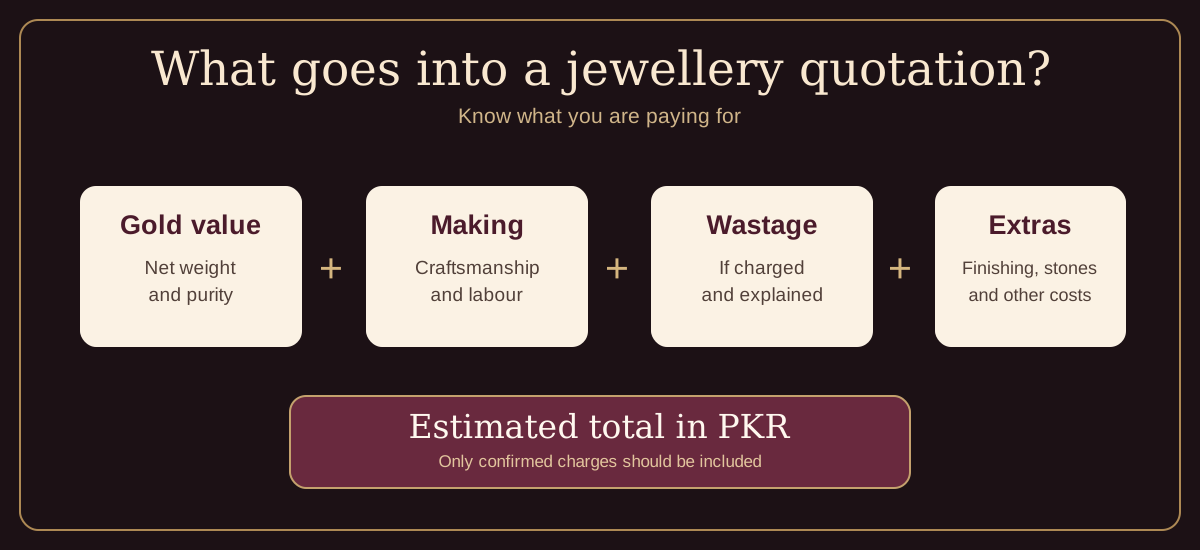
A bangle, ring or necklace has a gold value, but its finished price can also include labour and other work. Before you approve a design, ask the jeweller to show you the gold weight, purity, gold rate and every additional charge. That is more useful than being told only the final amount.
Gross weight and net gold weight
Gross weight is everything put on the scale. When a design includes non-gold stones, beads or other material, the gold value should be calculated on the gold portion, not on the decorative components. Ask for both weights to be written down, particularly for detailed bridal sets.
The price of gold also depends on purity. At the same market rate and weight, 22K, 21K and 18K jewellery will have different metal values. Ask whether the rate being used is quoted for 24K gold or already adjusted for the jewellery’s karat.
Making charges, also called banwai
Making covers the work of producing a finished piece. A plain band, an engraved kara and an intricate bridal necklace do not take the same effort to make. A shop might charge a fixed amount for the piece, an amount per gram or a percentage of the gold value.
Ask how making is calculated on your item. Then check whether polishing, stone setting and wastage are included in that amount. They should not be silently charged twice.
What does wastage mean?
Some jewellers add an allowance for manufacturing metal loss and related processes. Others include this in their making charges. There is no single wastage percentage that can reliably be applied to every design or jeweller in Pakistan.
For example, an allowance of 0.5 g on a 2 g ring is 25% of the finished gold weight. An allowance of 0.7 g on a 4 g ring is 17.5%. These are arithmetic examples, not established loss rates or recommended charges. If a quotation contains such an allowance, ask what work it covers, whether scrap gold is recovered and whether it is already included in making.
Wastage is not the same as buyback kaat
The word kaat can describe different deductions at jewellery counters. When selling old jewellery, it may refer to assessed purity, non-gold weight or the buyer’s deductions. When making new jewellery, a jeweller may describe a separate wastage allowance. Those are not interchangeable charges.
If you are selling back an item, ask for the weight, purity, market rate and each deduction. The purchase-side quotation should separately identify the costs of a new item.
What should a bangle receipt show?
For bangles or karas, the receipt should make it clear whether the listed weight is for one piece or for the full pair or set. It should also identify the metal purity, size, current rate used, making charges, any separately agreed wastage, finishing and other applicable charges.
| Receipt line | What to verify |
|---|---|
| Gold rate | Date, rupees per tola or per gram, and karat basis |
| Gross weight | Whole item or complete pair |
| Net gold weight | Non-gold material excluded where relevant |
| Wastage | Grams or percentage, and whether included in making |
| Making | Fixed fee, per gram or percentage |
| Other charges | Polishing, stones, delivery or applicable taxes |
| Total | Quote expiry and what changes if final weight differs |
Ask for a final itemised quote
Gold rates change and finished pieces may differ slightly in weight from an initial estimate. An online calculator is useful for checking the arithmetic, but cannot confirm purity, stock, gemstone authenticity or the final shop price. You can also use our gold buying estimator for a basic metal-and-making calculation.
At Hira Jewellers, share the design reference and your preferred size when asking for a quotation. Ask us to confirm the actual specifications before ordering. A clear receipt is the best way for both sides to know what has been agreed.